About 29 Earths Would Fit in the Gap Between Earth and the Moon
Textbook drawings put the Moon almost next door. In reality the gap is wide enough to line up about 29 Earths side by side, and the number changes as the Moon swings closer and farther during each orbit.
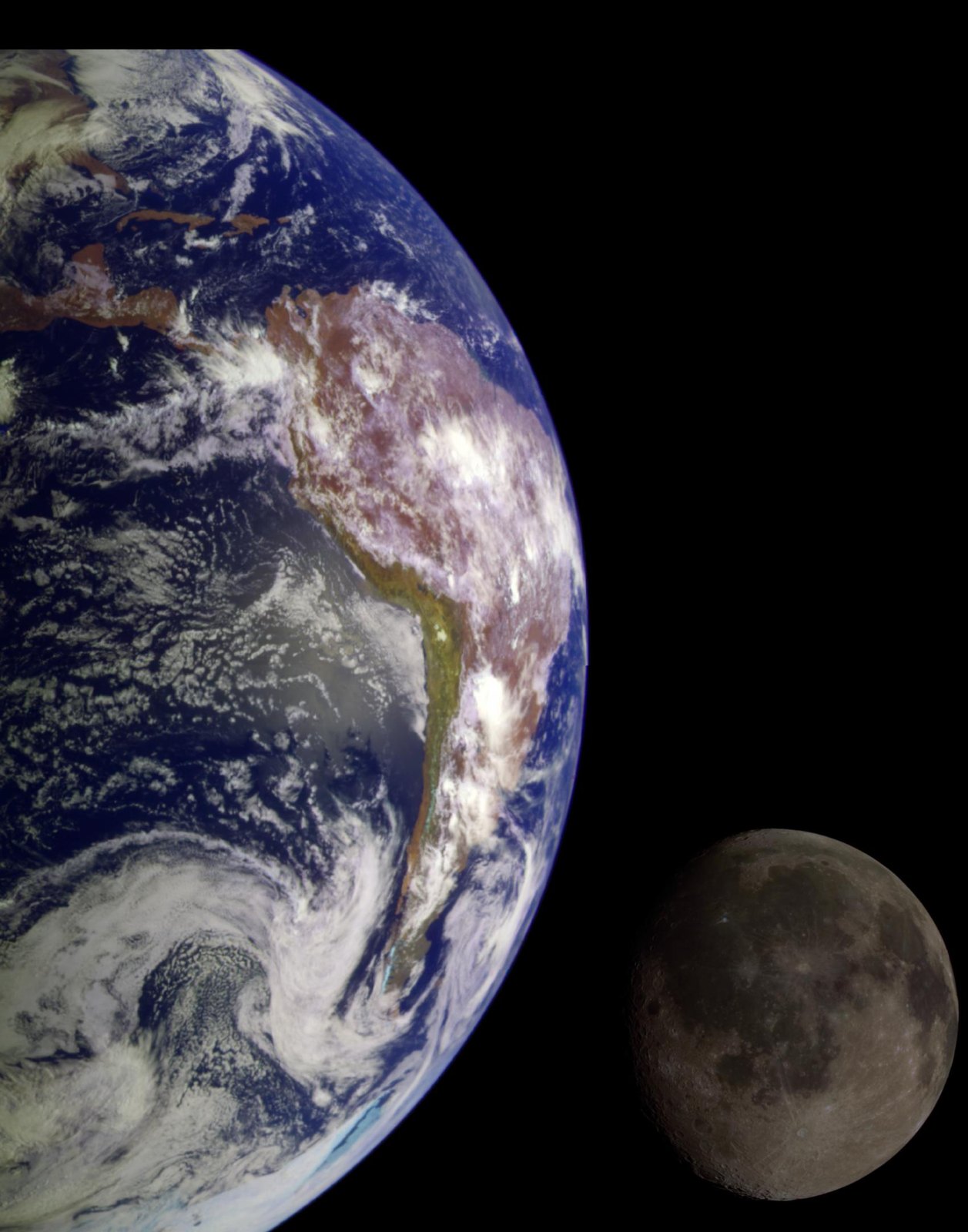
Most pictures of Earth and the Moon squeeze them into the same frame, a few planet-widths apart. The real gap is far bigger. On average, the Moon sits about 238,855 miles (384,400 km) from Earth, center to center, according to NASA's Moon fact sheet.
Doing the math
To see how many Earths fit, you have to measure the empty space between the two surfaces, not from center to center. Earth's mean radius is about 3,959 miles (6,371 km) and the Moon's is about 1,080 miles (1,737 km). Take those away and the open gap is roughly 233,800 miles (376,300 km).
Earth is about 7,918 miles (12,742 km) wide. Divide the gap by that and you get about 29.5. So 29 Earths fit in a row with room to spare, but a 30th would not quite make it.
The number changes every month
The Moon's orbit is not a perfect circle. At its closest point, called perigee, the Moon comes within about 225,700 miles (363,300 km) of Earth. At its farthest, apogee, it drifts out to about 252,000 miles (405,500 km). Run the same math and the gap holds just under 28 Earths at perigee and a little over 31 at apogee.
Other ways to picture it
- Light covers the average distance in about 1.3 seconds. A radio call to an astronaut on the Moon has a noticeable delay.
- Walking nonstop at 3 mph (5 km/h), you would need almost 9 years to get there.
- The Moon looks large in the sky only because it is close by cosmic standards. Its diameter is a bit more than a quarter of Earth's.
The image above was put together from separate photos taken by NASA's Galileo spacecraft on its way to Jupiter, so the two worlds are shown much closer together than they really are. Next time you see the Moon, picture that long row of 29 Earths stretching between you and it.
Enjoyed this story?
Get new space stories and 3D space-fact Reels in your Facebook feed every day.