Halley's Comet Has Turned Around and Is Heading Back for 2061
Halley's Comet reached the far end of its orbit in December 2023, crawling along at about 2,000 mph. It is now falling back toward the Sun and will be moving more than 60 times faster when it arrives in July 2061.
The most famous comet in history is on its way back. After decades of drifting outward, Halley's Comet reached its farthest point from the Sun on December 9, 2023 and has been falling back toward the inner solar system ever since. Its next closest pass by the Sun is due on July 28, 2061.
From a crawl to a sprint
How fast Halley moves depends entirely on where it is. At the far end of its orbit, more than 3.2 billion miles (5.2 billion km) from the Sun and well beyond Neptune, the comet slows to roughly 2,000 mph (0.91 km/s). By space standards, that is barely moving.
Close to the Sun it is a different story. At its last closest approach, on February 9, 1986, Halley passed just 54.6 million miles (87.8 million km) from the Sun, inside the orbit of Venus, and NASA clocked it at about 122,000 mph (54.55 km/s). That is more than 60 times faster than its speed at the far end.
Why it speeds up
Nothing pushes the comet. As Halley falls toward the Sun, gravity pulls harder and harder and the comet picks up speed, the way a skateboarder speeds up rolling down into a half-pipe. On the way back out, gravity slowly drags it to a crawl again. Johannes Kepler described this pattern four centuries ago: an object on a stretched orbit sweeps fastest when it is closest to the body it orbits.
Going the "wrong" way
Halley is unusual in another way. NASA notes that it travels around the Sun backward, opposite to the direction Earth and the other planets move, in an orbit tilted about 18 degrees to ours. A full lap takes about 76 years.
What we learned last time
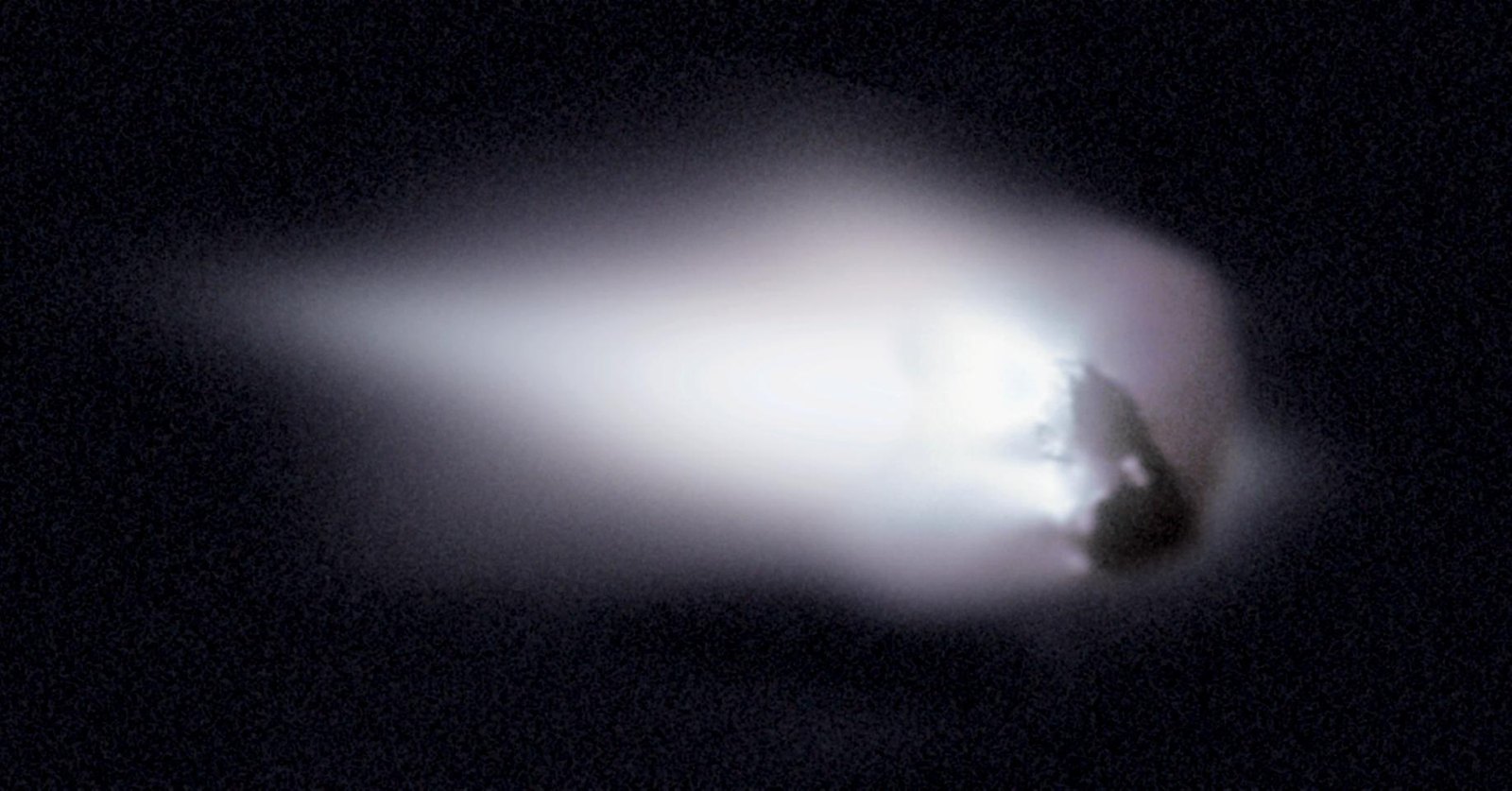
During its 1986 visit, an international fleet of spacecraft went to meet it. Europe's Giotto probe flew past the nucleus in March 1986 and returned the image above: a dark, potato-shaped body spraying jets of gas and dust from its sunlit side. It was one of the first times any spacecraft had photographed the heart of a comet.
The road back
The return trip takes decades. According to a timeline published by Space.com, Halley should cross Neptune's orbit in 2041, Saturn's in late 2058 and Jupiter's in 2060 before sweeping past the Sun in July 2061. If you saw it in 1986, you may get a second look. If you didn't, mark the date.
Enjoyed this story?
Get new space stories and 3D space-fact Reels in your Facebook feed every day.