Webb Peers Into N159, a Turbulent Star Nursery Next Door
Webb's new view of N159 in the Large Magellanic Cloud shows thousands of newborn stars forming in conditions similar to the early Universe.
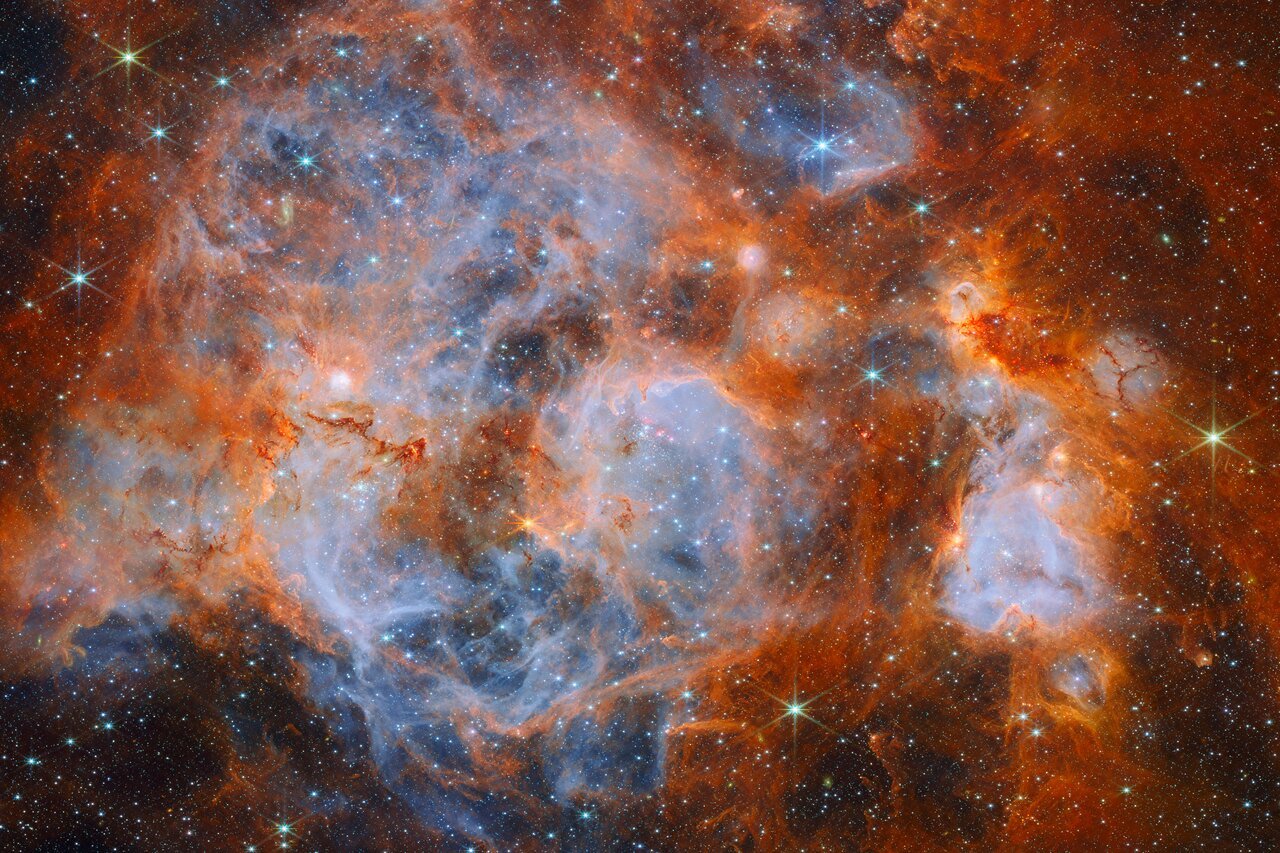
The James Webb Space Telescope's latest Picture of the Month shows N159, a turbulent star-forming region in the Large Magellanic Cloud, a satellite galaxy of the Milky Way about 161,000 light-years away. The image spans about 230 light-years.
A cauldron of newborn stars
N159 is an H II region, a cloud of hydrogen gas ionised by intense ultraviolet light from massive, hot young stars. Their fierce winds carve out cavities and sculpt dense ridges. In Webb's near-infrared view, smoky orange clouds glow with light from carbon-based molecules called polycyclic aromatic hydrocarbons, pale blue pools mark ionised gas, and dark red filaments of cool molecular hydrogen cross the centre, shielding stars that are still forming inside them.
A window on the early Universe
The Large Magellanic Cloud has a much lower proportion of elements heavier than hydrogen and helium than our galaxy. That makes regions like N159 a useful stand-in for the conditions in which stars formed in the early Universe.
Young, crowded and still collapsing
At less than three million years old, N159 is one of the youngest star-forming regions in the LMC and contains thousands of stars in their earliest stages. The bright spot on the left of the image is the compact Papillon Nebula, first resolved by Hubble in 1999. Using these Webb data, astronomers detected stars less than a tenth the mass of the Sun and found that the western part of N159 holds more young stellar objects packed closely together, a sign that it is at an earlier stage of collapse.
Enjoyed this story?
Get new space stories and 3D space-fact Reels in your Facebook feed every day.