Hubble and Webb Spot a Ghostly Cat's Head Nebula
In the Carina Nebula, 7,500 light-years away, a dark pillar shaped like a sitting cat is being sculpted by the light and winds of massive stars.
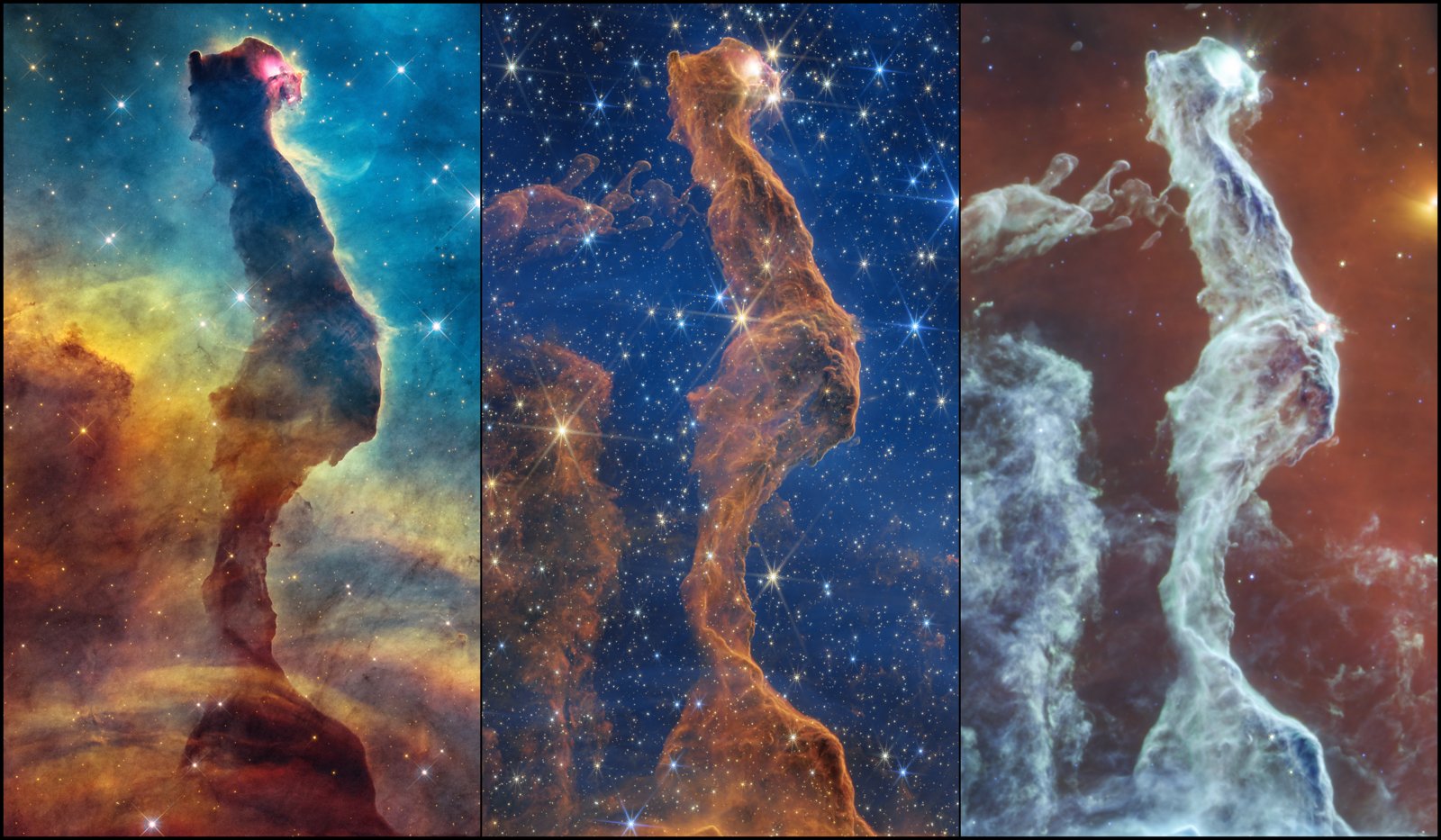
Two of the most powerful telescopes ever built have turned toward the same small patch of the Carina Nebula, a vast cloud of gas and dust about 7,500 light-years from Earth, and found a shape that looks right on time for Halloween: a dark pillar that resembles a cat sitting with its back to us, its head turned to the right and one glowing eye looking out.
A pillar that refuses to fade
Astronomers think the "cat" was sculpted by the intense ultraviolet light and powerful winds of massive stars elsewhere in the Carina Nebula. As that radiation eats away at the surrounding gas and dust, the denser material inside the pillar resists, at least for now. Along its right-hand edge, Hubble sees a hazy, glowing rim: gas being heated and slowly evaporated by the starlight.
Three views of the same cat
In Hubble's visible light, the cat is an opaque, dark brown column of dust, and its red eye may be a young star still partly buried in its birth cloud. Webb's near-infrared camera sees through much of that dust, revealing a crowd of stars and even faint galaxies far behind our own Milky Way. Webb's mid-infrared view traces warm dust and carbon-based molecules, picking out delicate strands and globules to the left of the pillar and a bright source on the right that is likely an infant star wrapped in dust.
A temporary scene
The Cat's Head Nebula will not last forever. As new stars form and the surrounding radiation keeps working, the pillar will eventually disperse. For now, the combined Hubble and Webb views give astronomers a detailed snapshot of the messy, complex process of star birth.
Enjoyed this story?
Get new space stories and 3D space-fact Reels in your Facebook feed every day.