Euclid Discovers Its First New Comet
ESA's galaxy-mapping telescope has found comet C/2026 S1 (Euclid), arching high above the planets about 1.3 billion km from Earth.
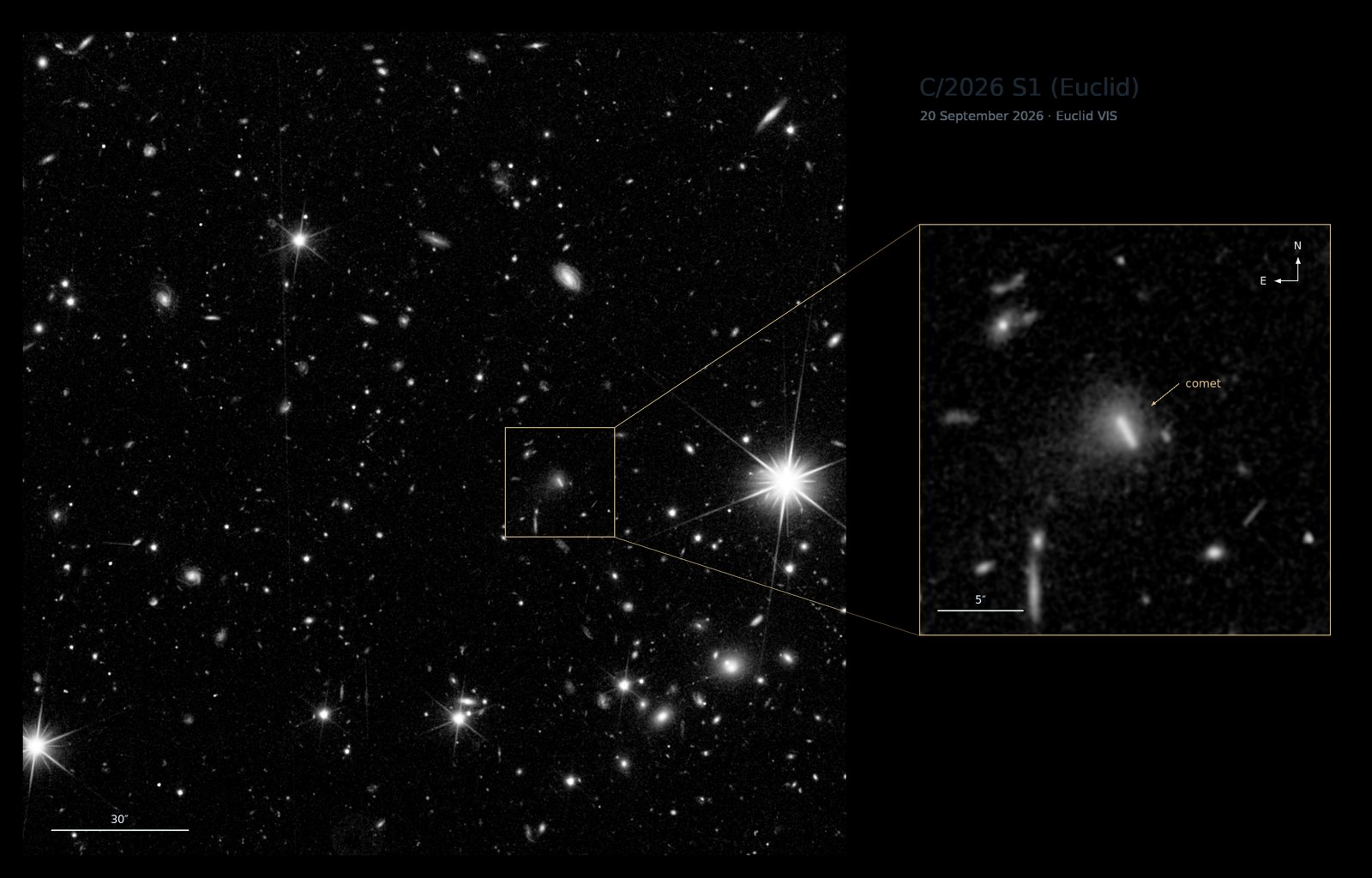
ESA's Euclid space telescope was built to map billions of distant galaxies, not to hunt comets. Yet in images taken between 16 and 24 September 2026, it spotted its first previously unknown comet, now officially named C/2026 S1 (Euclid).
A streak with a fuzzy glow
Mikko Pöntinen, a PhD student at the University of Helsinki, found it with moving-object detection software he developed for Euclid's images. The software flagged a streak smeared across several frames, and closer inspection revealed a fuzzy cloud of dust and gas around it, the tell-tale coma of an active comet. In total it appeared in five image sets.
Confirmed as new
No known comet or asteroid matched, so the observations were reported to the International Astronomical Union's Minor Planet Center. Ground-based astronomers followed up, and the Minor Planet Center confirmed the comet on 8 October.
High above the planets
The comet is about 1.3 billion km from Earth, roughly the distance from the Sun to the region between Jupiter and Saturn. But it is not travelling in the plane of the planets: from the Sun's point of view it is currently "straight up", arching over the Solar System on an orbit that takes thousands of years to complete.
Why the discovery is so unusual
Euclid deliberately avoids the comet- and asteroid-rich band of sky along the plane of the Solar System, and it usually photographs each patch of sky only once. Finding a new comet was a lucky coincidence, but it also shows how Euclid could flag future targets for ESA's Comet Interceptor mission.
Enjoyed this story?
Get new space stories and 3D space-fact Reels in your Facebook feed every day.