Giant Bubbles Tower 25,000 Light-Years Above and Below Our Galaxy's Center
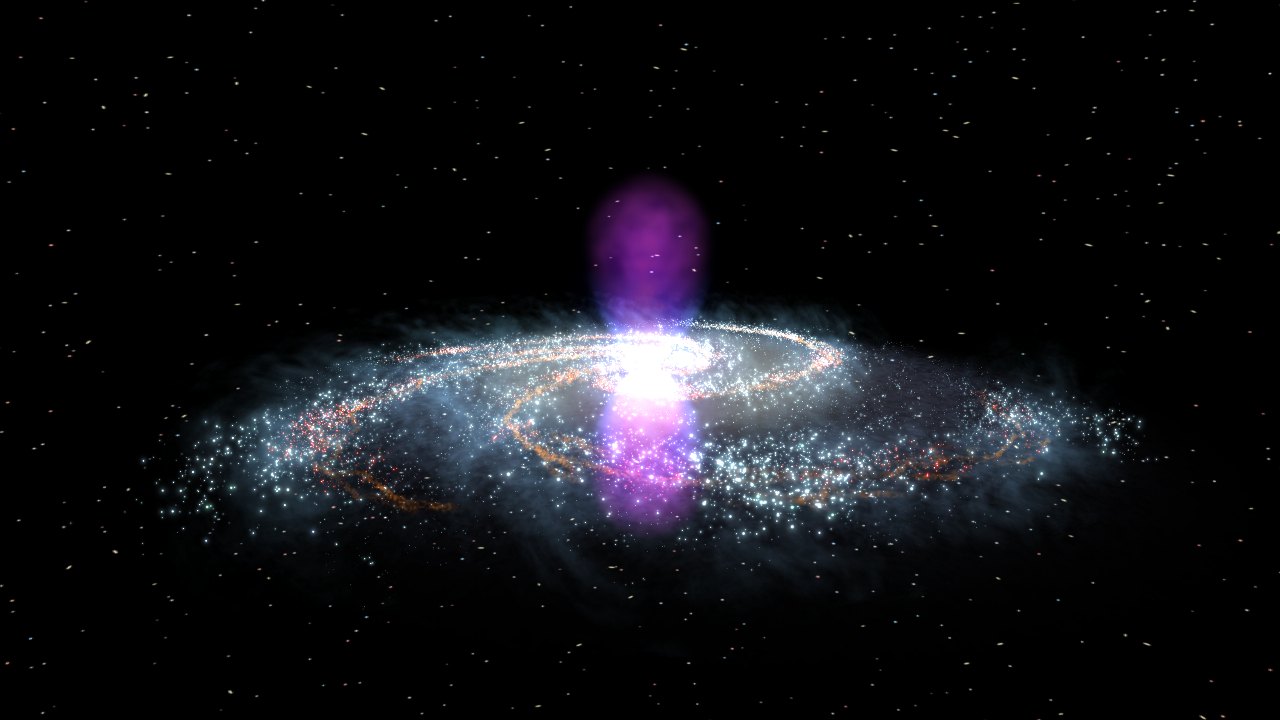
In 2010 NASA's Fermi telescope revealed two enormous lobes of gamma-ray light rising from the heart of the Milky Way. Together they span about 50,000 light-years, and what blew them out is still an open question.
The center of the Milky Way is famous for its supermassive black hole, Sagittarius A*, which holds about 4 million times the mass of our Sun. But something even larger is towering over it, and we only noticed it in 2010.
A discovery hiding in plain sight
That year, astronomers led by Doug Finkbeiner of the Harvard-Smithsonian Center for Astrophysics dug into public data from NASA's Fermi Gamma-ray Space Telescope. Gamma rays are the most energetic form of light, and the whole sky glows faintly with them, a kind of fog produced when fast particles collide with gas and light in our galaxy. Once the team modeled and removed that fog, two huge shapes stood out.
They were a pair of bubbles rising from the galactic center, one above the disk of the Milky Way and one below. NASA says each lobe extends about 25,000 light-years, so together they span about 50,000 light-years, roughly half the width of the galaxy itself. Seen from Earth, they stretch across more than half of the visible sky, from the constellation Virgo to Grus.
Something blew them out
The bubbles have sharp edges, and their light is more energetic than the gamma-ray glow elsewhere in the galaxy. Both clues point to a large, relatively sudden release of energy, and NASA says the whole structure may be only a few million years old, young by galactic standards.
What caused it is still debated. One idea is that Sagittarius A* was once far more active and fired off a powerful jet or outflow as it swallowed gas. Another is a burst of star formation near the center, perhaps the one that produced many massive star clusters there several million years ago, pushing huge amounts of gas outward. Hints of the bubbles' edges had already shown up in older X-ray and microwave data, but Fermi was the first to reveal their full shape.
Why we can't just look up and see them
Gamma rays do not reach the ground. Earth's atmosphere absorbs them, which is good news for life and bad news for astronomers. The only way to map the bubbles is from orbit, and even then it took careful processing to pull them out of the background glow.
Next time you see the Milky Way on a dark night, remember that the band of stars is only part of the picture. Rising out of its center are two invisible structures tens of thousands of light-years tall.
Enjoyed this story?
Get new space stories and 3D space-fact Reels in your Facebook feed every day.