NASA's Lucy Becomes the First Spacecraft to Reach the Trojan Asteroids
After 2.2 billion miles and five years in space, Lucy has entered the region of the Jupiter Trojan asteroids, with its first flyby set for August 2027.
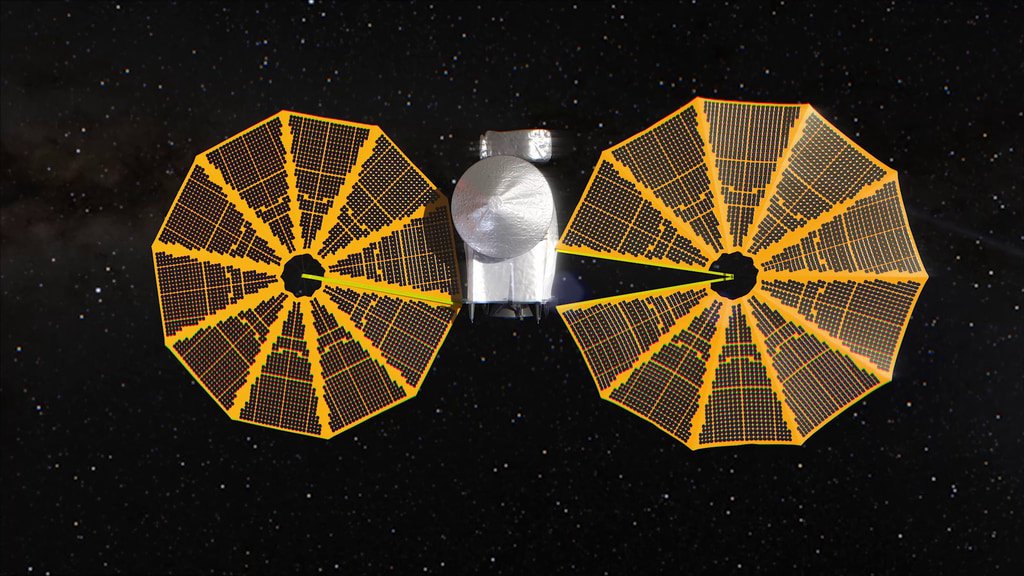
Five years after it left Earth, NASA's Lucy spacecraft has become the first mission ever to enter the region of the Jupiter Trojan asteroids. Since its launch on October 16, 2021, Lucy has traveled more than 2.2 billion miles (about 3.5 billion kilometers) to get there.
The Trojans are thousands of asteroids that share Jupiter's orbit around the Sun, gathered in two large groups: one travels ahead of the giant planet and the other trails behind it. They sit around two points of balance, known as Lagrange points 4 and 5, where the pull of the Sun and Jupiter combine to hold them in place. These swarms are as far from Jupiter as Jupiter is from the Sun, about 484 million miles (around 780 million kilometers).
Pinpricks of light, for now
Space is still very empty out there. The Trojans are separated by more than 6 million miles (about 10 million kilometers) on average, so they will look like tiny moving points of light against the stars until Lucy closes in on its targets. Engineers know Lucy is approaching the leading group, around Lagrange point 4, by tracking its radio signals and the stars around it.
Other spacecraft have flown past Jupiter, but none has visited the Trojans. Scientists hope that studying these primitive bodies up close will help explain how the planets of our solar system formed 4.5 billion years ago and how they ended up where they are today.
What comes next
Lucy is now more than five times farther from the Sun than Earth is, and NASA says the spacecraft and its instruments are working as expected in the colder, dimmer conditions. Its first Trojan flyby, of the asteroid Eurybates, is set for August 11, 2027. Then come Polymele in September 2027, Leucus in April 2028 and Orus in November 2028. In 2030 Lucy will swing past Earth one last time for a gravity assist that sends it toward the trailing group, where it will visit the binary pair Patroclus and Menoetius in March 2033.
Enjoyed this story?
Get new space stories and 3D space-fact Reels in your Facebook feed every day.