Hera Sees Its Two Target Asteroids Separately for the First Time
From 1,280 km away, ESA's Hera spacecraft has resolved Dimorphos, the asteroid hit by NASA's DART in 2022, as a separate dot beside its parent Didymos.
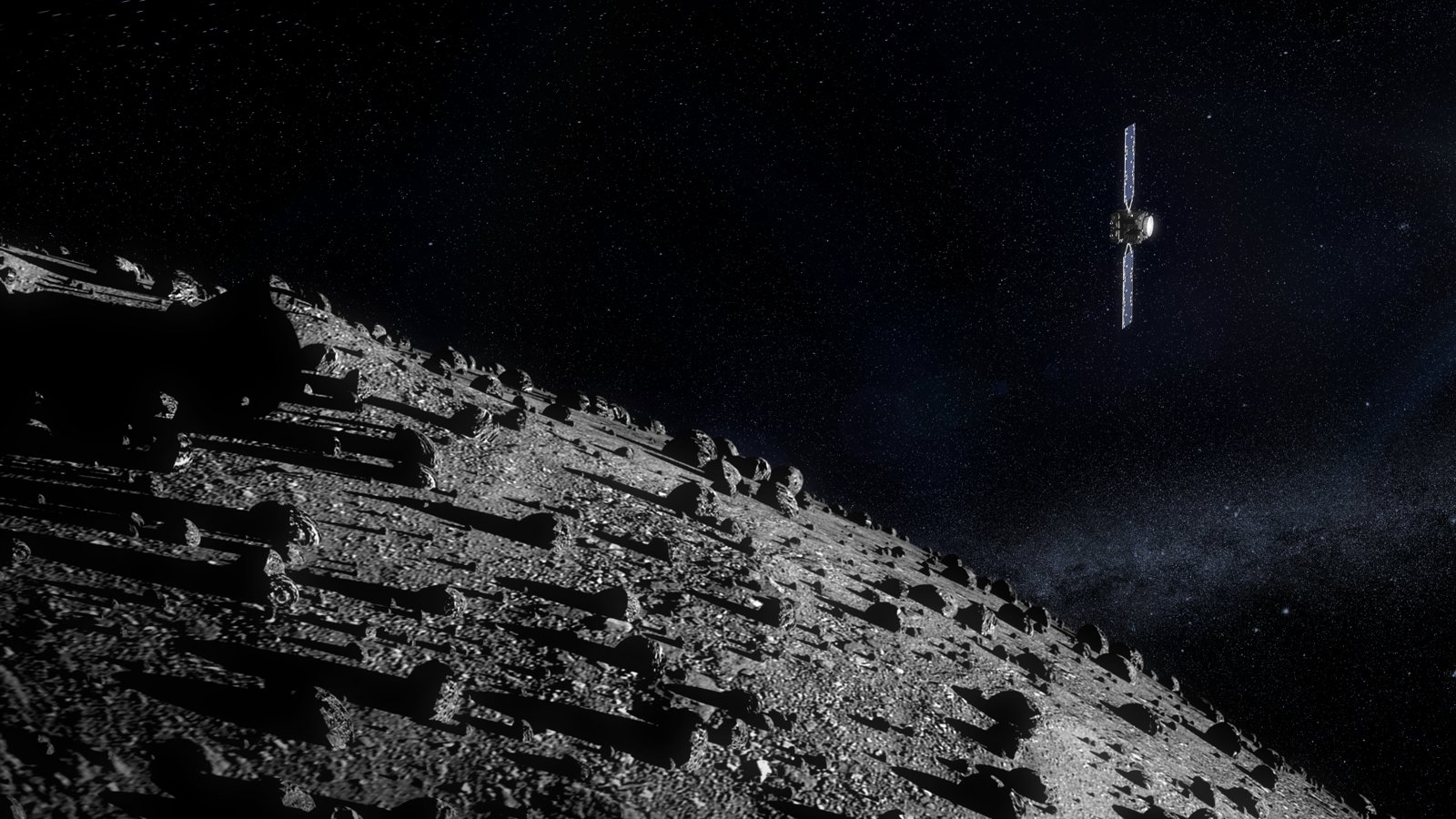
Europe's planetary defence spacecraft Hera has, for the very first time, seen its two target asteroids as separate objects. Until now, the Didymos system appeared to Hera's cameras as a single dot. In a new image taken with its Asteroid Framing Camera on 18 October, from about 1,280 km away, the small moon Dimorphos finally shows up next to its larger parent.
One pixel, big milestone
In this first-light image Dimorphos covers only around one pixel, but it is clearly separated from Didymos. The view came after two braking burns, a week apart, slowed Hera to just 20 m/s relative to the asteroids so it can close in gradually. The asteroid pair are currently some 197 million km from Earth.
Meet the double asteroid
Dimorphos is about 151 m across, roughly the size of the Great Pyramid of Giza, while Didymos is about 780 m wide. The two orbit an average of 1.15 km apart, with Dimorphos circling its parent at about 18 cm per second.
Returning to the scene of the impact
On 26 September 2022, NASA's DART spacecraft deliberately crashed into Dimorphos at 6.1 km/s, shortening its orbit around Didymos by around 33 minutes. Hera's job is a close-up "crash site investigation": finding out whether DART left a crater or reshaped the asteroid, and measuring Dimorphos's makeup, structure and mass. ESA plans to reveal the first detailed images of Dimorphos on 25 November.
Enjoyed this story?
Get new space stories and 3D space-fact Reels in your Facebook feed every day.